By Wiyao Awesso, Realtor®, VA Loan Specialist & Loan Officer, U.S. Navy veteran | DRE# 02058584 | NMLS# 1939042 | Updated November 2026
Quick answer: If you bought at a high interest rate and your payment is getting hard to make, act before you miss a payment. Build a real budget, call your servicer to ask about options while you're still current, check whether a refinance or loan recast makes sense, and talk to a free HUD-approved housing counselor. If the home no longer fits your budget, selling while you're current protects your credit and equity far better than waiting.
Why So Many Buyers Are Feeling Squeezed
Mortgage rates climbed sharply in 2022 and 2023. Freddie Mac's weekly survey of 30-year fixed rates peaked near 7.8% in late October 2023. Many Riverside County buyers who purchased then are carrying payments hundreds of dollars higher than they would at today's rates. Add higher homeowners insurance, property tax bills, and everyday costs, and a payment that felt fine at closing can start to pinch.
Foreclosure filings have increased in 2026 compared with 2025, according to ATTOM, though they remain low by historical standards. The homeowners who come out best are the ones who act early.
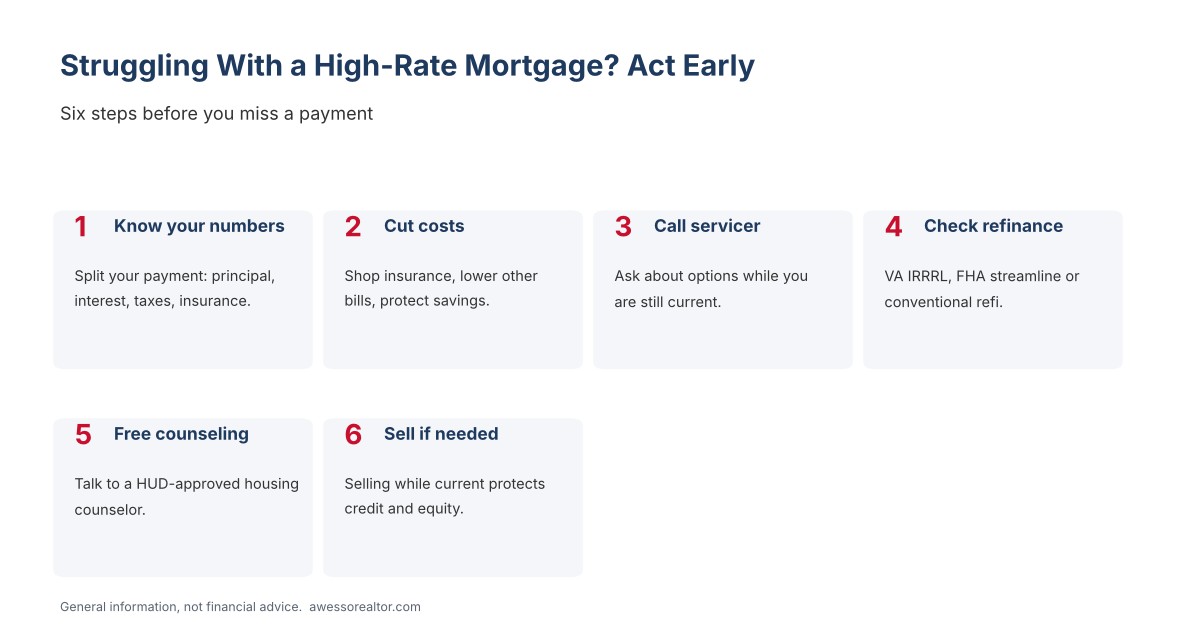
Step 1: Know Your Real Numbers
Write down your take-home income and every monthly bill. Then look at your mortgage statement and split the payment into its parts:
- Principal and interest: this only changes if you refinance, modify or recast.
- Escrow: property taxes and insurance, which can rise every year. Read why your mortgage payment went up.
- Mortgage insurance: on many FHA and low-down-payment conventional loans.
Knowing which part grew tells you which fix to try first.
Step 2: Cut and Reshuffle Before You Borrow
- Shop your homeowners insurance and ask about a higher deductible.
- Pause extra savings or investments temporarily, not your emergency fund.
- Call car, credit card and phone providers about lower payments or hardship programs.
- Avoid covering the mortgage with credit cards or payday loans, which usually makes things worse.
Step 3: Call Your Servicer While You're Still Current
Many people wait until they're behind to call. You don't have to. Ask your servicer:
- What options exist if I'm struggling but haven't missed a payment yet?
- Can my escrow shortage be spread over more months?
- Does my loan allow a recast if I make a lump-sum payment?
- What happens to my credit if I enter forbearance?
Write down the date, the representative's name and what they said.

Step 4: Check Your Refinance Options
If rates have dropped since you bought, a refinance may lower your payment. Questions to answer first:
| Option |
Who it's for |
Key point |
| VA IRRRL (streamline) |
Current VA loan holders |
Often no appraisal or income verification; must lower the rate or improve the loan |
| FHA streamline |
Current FHA loan holders |
Reduced paperwork; must show a net benefit |
| Conventional rate-and-term refinance |
Most borrowers with equity |
Needs an appraisal, credit and income check |
| Loan recast |
Borrowers with a lump sum to pay down |
Lowers the payment without changing the rate; not all loans allow it |
Compare the closing costs with the monthly savings to find your break-even point. If you'll move before you break even, the refinance may not help. Use the mortgage calculator to compare payments.
Step 5: Talk to a Free HUD-Approved Counselor
HUD-approved housing counselors can review your budget and help you talk to your servicer, usually at no cost. Find one through the Consumer Financial Protection Bureau's counselor search. Never pay upfront fees to anyone promising to lower your payment.
Step 6: If You Do Fall Behind
If a missed payment becomes likely, call your servicer immediately and ask for a loss mitigation application. Options can include forbearance, a repayment plan, a loan modification or, for FHA and VA loans, a partial claim. California's Homeowner Bill of Rights gives owner-occupants protections during this process. Read the full guide: can't afford your mortgage anymore? Your options in California.
When Selling Makes Sense
If the payment won't fit your budget even after changes, selling while you're current is often the smartest move:
- You keep any equity you've built.
- Your credit stays intact for your next home or rental.
- You control the timing and price instead of a foreclosure deadline.
If you bought recently, you may have little equity after selling costs. A home value check tells you where you stand. Request a free home value report.

Other Options to Consider
- Rent a room: extra income can bridge the gap, but check HOA and local rules.
- Rent out the home and move somewhere cheaper: only works if the rent covers the payment and you can manage it.
- Military homeowners: ask about SCRA protections and contact your base legal assistance office.
Warning Signs to Act Now
- You're using credit cards to make the mortgage payment.
- Your emergency savings are almost gone.
- Your escrow analysis shows a large shortage.
- Your income dropped and isn't coming back soon.
A Simple Monthly Budget Check
| Line |
Ask yourself |
| Take-home pay |
Is it steady, or did it drop recently? |
| Mortgage payment |
Is it more than about a third of take-home pay? |
| Other debts |
Which ones can be lowered, paused or paid off? |
| Savings |
How many months could you cover the mortgage? |
| Upcoming changes |
Escrow increase, new baby, job change, PCS? |
How Much a Lower Rate Could Save
Here's the principal-and-interest payment on a $500,000, 30-year loan at different rates:
| Rate |
Monthly principal and interest |
| 7.50% |
About $3,496 |
| 6.50% |
About $3,160 |
| 5.75% |
About $2,918 |
A one-point drop saves roughly $300 or more a month on this example. Closing costs and your remaining balance change the real benefit, so get a written quote before deciding.
What Not to Do
- Don't ignore calls and letters from your servicer.
- Don't pay anyone upfront to "save" your home or lower your payment.
- Don't sign over your deed to someone promising to help.
- Don't drain retirement accounts without talking to a tax professional first.
Questions to Ask Before Selling
- What would I net after commissions, closing costs and payoff?
- Where would I live next, and what would it cost?
- Would renting the home cover the payment instead?
- How would selling now affect my taxes?
Related Guides
Frequently Asked Questions
Can I call my lender before I miss a payment?
Yes, and you should. Servicers can explain options before you fall behind, and early action keeps more doors open.
Should I refinance if rates drop?
It can make sense if the monthly savings cover the closing costs before you plan to move. VA and FHA streamline refinances can lower costs for eligible borrowers.
Will asking for help hurt my credit?
Asking questions doesn't hurt your credit. Some options, like forbearance, may be reported differently, so ask your servicer how each option is reported.
Is it better to sell or try to keep the house?
It depends on your budget, equity and plans. If the payment won't fit long term, selling while current usually protects your credit and equity best.
Talk It Through, Confidentially
If your payment is stretching your budget, call or text me at 951-282-7007. I'll help you understand your home's value and your options, and point you to free counseling resources. No pressure.
#MortgageHelp #HighInterestRate #Refinance #VAIRRRL #ForeclosurePrevention #RiversideCounty #Murrieta #Temecula #Homeowners #California #PersonalFinance
Sources: Freddie Mac Primary Mortgage Market Survey; ATTOM 2026 mid-year foreclosure report; Consumer Financial Protection Bureau; U.S. Department of Veterans Affairs. This article is general information, not legal, tax or financial advice. Talk to a HUD-approved housing counselor, your servicer or an attorney about your situation.

About the Author
Wiyao Awesso
Realtor® | VA Loan Specialist & Loan Officer | U.S. Navy Veteran
Wiyao is a Murrieta-based Realtor® and licensed loan officer who specializes in VA loans and military relocation. After about 20 years in the U.S. Navy, he helps service members, veterans and first-time buyers buy, sell and finance homes across Riverside and San Diego counties, from the first showing to the closing table.
DRE# 02058584 | NMLS# 1939042 | 951-282-7007 | More about Wiyao
Get a VA Loan QuoteApply Now